
Rory's Story Cubes for your Landscape stories...

During my lunch-time at the Education Show I took the opportunity to do a quick trip up and down the aisles to make sure that I saw as many of the stands as possible and have a chat to anyone who had a geographical connection, or who caught my eye.

One stand I particularly wanted to see was the CREATIVITY HUB stand, where RORY's STORY CUBES were available.

I have these cubes as an iPhone app and also as the infinitely preferable 'real thing', and have used them with many teachers over the last few years to explore the ideas of geography as "writing the earth".

I have used my cubes with hundreds of teachers as a way of exploring creative writing, including my sessions at various conferences. By using a net for creating a cube such as the one below, taken from MATHSISFUN with thanks, you can also add your own cubes...
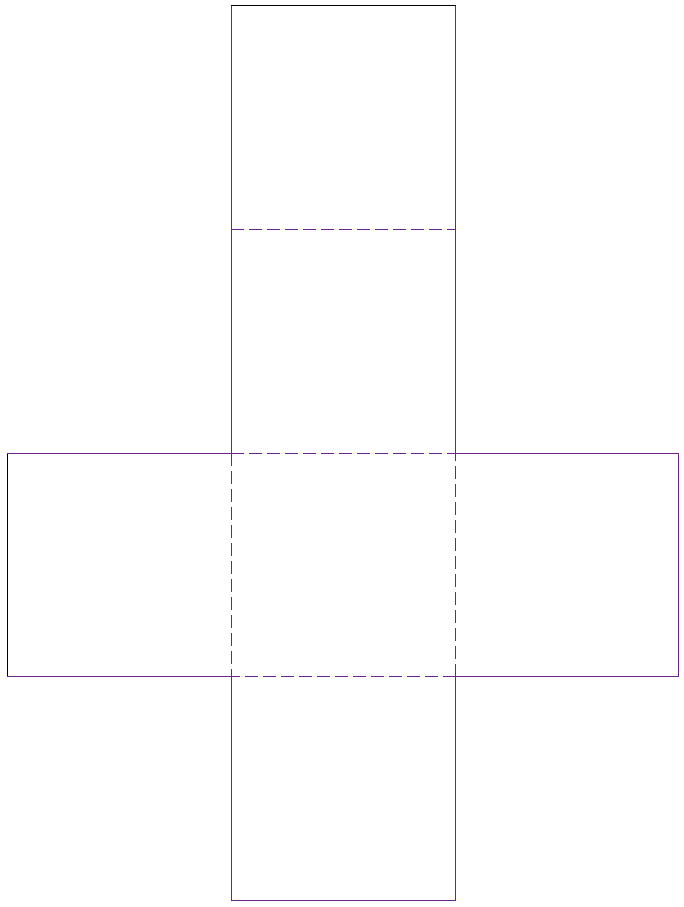
Cut out the shapes and add your own words or instructions on the six sides relevant to the subject that you are using them for.

If you were making a set of geography cubes, they might contain instructions. These could be used to add a map symbol or place name, to turn a particular compass direction (to direct a route across an OS map sheet perhaps), or to describe a particular landscape.

I got a set of ACTIONS cubes to mix in with them, and had a chat with Rory - who looks just like his picture on the flyer.

I was also really impressed with the MAX cubes, and a bit disappointed that they were only prototypes and not available to buy - not yet anyway... Follow the link to add your thoughts on whether they should be made more widely available for the particular reasons that are suggested.
Follow Rory and the team on Twitter @storycubes, and read this story from the Belfast Telegraph for some information on what they are planning yet. Some interesting projects to come...

Comments

Popular posts from this blog

Explore the world with the Go Jetters

Really useful post and resource for those teaching Primary Geography . A new set of characters called the Go Jetters who teach young people about key geographical ideas. Geography helps children to make sense of their world. Very young children are naturally curious, and they love to actively explore the world around them, noticing all kinds of detail. That’s why they need to develop geographical vocabulary like the names of places, people and things, and the words needed to describe and locate them. It helps to think of children as little geographers – they each have their own world of private geographies  - the places they name for themselves with meanings that only they understand: the dens where they hide out with their friends, special meeting places in the school playground. Whether they’re playing in the back garden, or splashing through a muddy puddle on the way to school, children are intrepid explorers making new (to them) discoveries about the world every sing...

Edward Storey - Fenland chronicler and poet

I have worked in the Fenland city of Ely for the last six years - commuting in all weathers and at all times through the Norfolk and Cambridgeshire Fens... Edward Storey has died at the age of 88. He was a chronicler of the Fens: an author and poet. There was a lovely piece on Edward on BBC Radio Norfolk that I heard yesterday on the way home, which described him as 'a poet of place'. You walk the roof of the world here. Only the clouds are higher And they are not permanent. Trees are too distant for the wind to reach And mountains hide below the horizon. The wind labours through reed As though they were the final barrier. Houses and farms cling like crustations To the black hull of the earth. Here, you must walk with yourself, Or share the spirits of forgotten ages. Keith Skipper has written a lovely piece in the EDP. More to come on Edward in a future blog post.... Image: Alan Parkinson - Fens near Manea - CC licensed

Making Space for Sand

  Making Space for Sand is a project I was made aware of recently. The ‘Building Community Resilience on a Dynamic Coastline by Making Space for Sand’ project (also known as Making Space for Sand or MS4S) is one of 25 national projects funded by DEFRA as part of the £200 million Flood and Coastal Innovation Programme (FCRIP).  The programme will drive innovation in flood and coastal resilience and adaptation to a changing climate. The project website has an excellent section outlining the formation of Sand Dunes, particularly within the located context of Cornwall. Sand Dunes are an important part of the coastal defences in the locations where they are found. I am particularly familiar with the dunes on the North Norfolk Coast at places like Holkham.  I've previously carried out fieldwork on those dunes with both GCSE and 'A' level students, and also  Atkins has provided GIS support and created some visualisations of future landscapes.